Cutting code review noise with Jev, a millisecond decision model
· 1 min read
- Code Review
- Software Engineering
- AI
- DevOps
- Productivity
- Machine Learning
Most code reviews waste human intelligence on things a mathematical model can do in ~33 milliseconds.
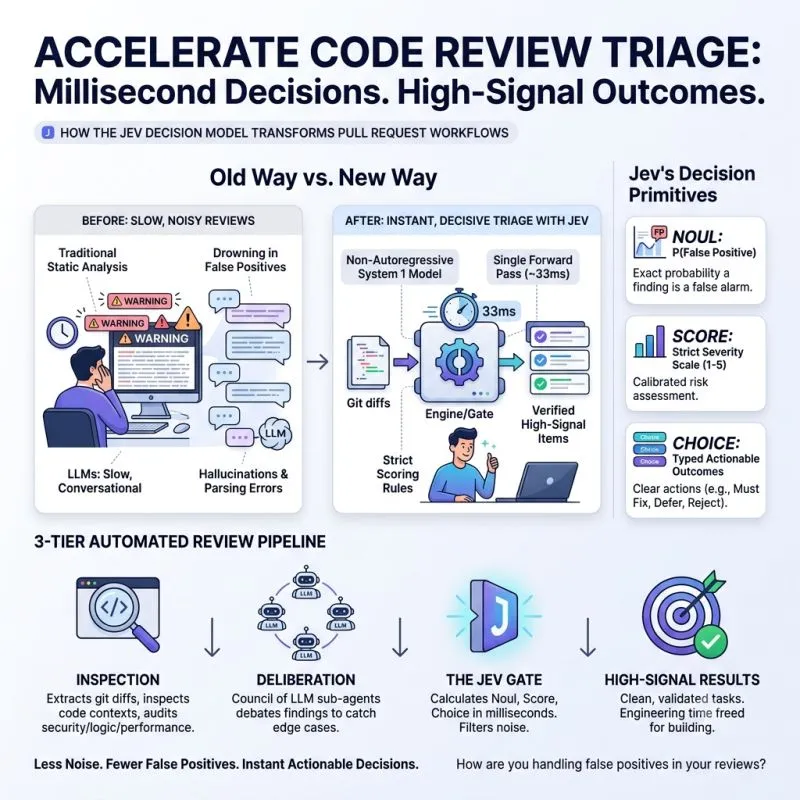
A few days ago, I was looking for a way to cut through the noise in automated pull request reviews. Traditional static analysis tools flag every potential issue, leaving engineers drowning in false positives. Generative LLMs help, but they are slow, prone to hallucination, and return conversational text when all you need is a hard decision.
Then I integrated Jev, and it completely transformed my PR workflow.
What is Jev?
Jev is a non-autoregressive “System 1” decision model. Instead of generating wordy text line-by-line like a traditional LLM, Jev evaluates code findings in a single forward pass (~33ms) and outputs calibrated decision primitives:
- Noul: The exact probability P(false positive) that an issue is a false alarm.
- Score: A strict severity scale (1 to 5).
- Choice: Typed actionable outcomes (e.g., Must Fix, Quick Fix, Defer, Reject).
Because it uses strict scoring rules instead of generative text, it never hallucinates and produces zero output parsing errors.
How I integrated Jev into my code review pipeline
I built a 3-tier automated review system for our pull requests:
- Tier 1 (Inspection): An automated runner extracts git diffs, inspects code contexts, and generates an initial audit report across security, logic, and performance.
- Tier 2 (Deliberation): A council of LLM sub-agents debates the findings to catch complex edge cases and architectural blind spots.
- Tier 3 (The Jev Gate): Every finding from Tier 2 is passed to Jev. It calculates Noul, Score, and Choice in milliseconds, instantly filtering out noise and low-priority items.
The result?
Only high-signal tasks with low false-positive rates make it into our final implementation plan.
By delegating risk calibration to a dedicated decision engine like Jev, we cut review triage time down to seconds, eliminated false positives, and freed up engineering time for actual building.